Back to Tips
Co-op Strategy GuideVerified March 31, 2026

Slay the Spire 2 Co-op Guide: Multiplayer Mechanics, Team Comps, and Scaling

A complete guide to Slay the Spire 2 co-op multiplayer covering HP scaling formulas, character pairing recommendations, coordinated drafting strategies, difficulty adjustments, and communication tactics for 2-4 player runs.
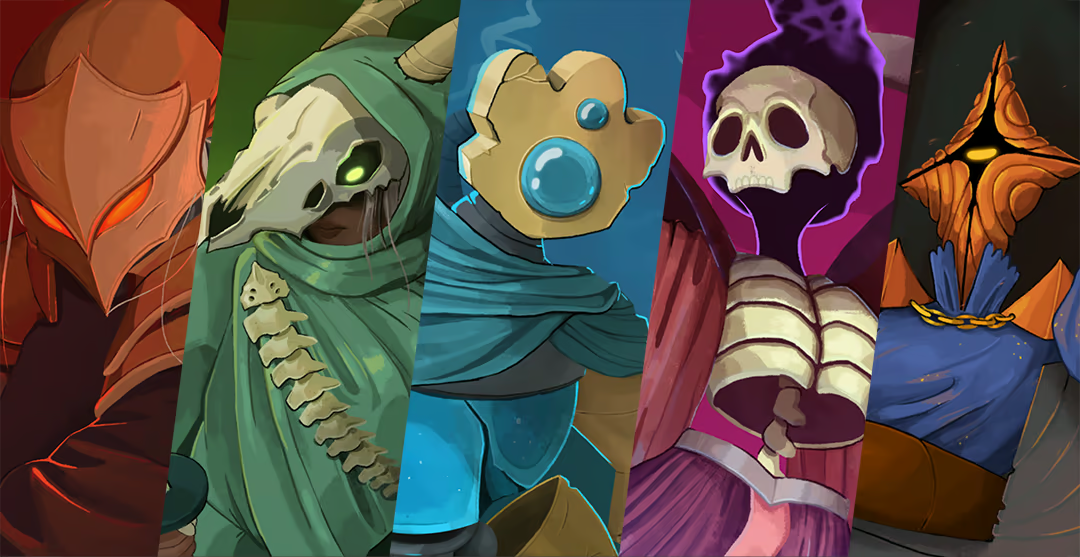
Official Slay the Spire 2 co-op banner used for the comprehensive co-op multiplayer guide
The co-op guide uses official multiplayer banner art because the page covers every aspect of the friends-only party play system.

Slay the Spire 2 supports 1-4 player co-op from day one of Early Access — a first for the franchise. Every run can be played with friends via Steam online multiplayer, where each player picks a different character and fights through the same encounters together.

Co-op fundamentally changes the game. Enemy HP scales with player count, making raw damage less efficient. Turn order is simultaneous, meaning all players play cards at the same time on the same enemies. Coordination on target focus, debuff application, and defensive responsibility becomes the difference between a smooth run and a floor 6 wipe.

This guide covers everything you need for successful co-op runs: how HP scaling works, which character pairings dominate, how difficulty adjusts per player count, and practical communication strategies for coordinating card plays in real time.

Verification note

Cross-referenced wikiwiki.jp detailed co-op specifications, kamigame.jp multiplayer guide and character tier list, patch notes through v0.101.0 (15+ multiplayer softlock fixes), and community co-op discussions. HP scaling values and mechanics verified against multiple Japanese wiki sources.

Fast takeaway

This guide is built around one practical question, so you can use it during a run instead of digging through a broad overview.

If the answer depends on a mechanic, a character system, or a recent patch, the related links show you what to open next.

Use this when you want a direct answer instead of a broad overview.

Follow the related links if this decision depends on a mechanic, character system, or co-op rule.

Check the update pages whenever balance changes might shift the recommendation.

Co-op Basics: How Multiplayer Works

Co-op in Slay the Spire 2 is online-only via Steam. There is no local co-op or split-screen. Each player must own their own copy of the game — shared library and free guest modes are not supported. One player hosts the run and invites others through Steam friends.

All players share the same map path, encounters, events, and shops. Each player controls their own character with their own deck, relics, potions, HP pool, and gold. Characters cannot be duplicated — each player must pick a different character from the five available (Ironclad, Silent, Defect, Necrobinder, Regent).

  • Simultaneous Turns — All players play their cards during the same turn phase. There is no turn order between players. Cards resolve in the order they are played, which matters for debuff stacking.
  • Shared Enemies — All players attack the same enemy pool. Players can independently target different enemies or focus fire on the same target. Communicating target priority is critical.
  • Independent Decks — Each player drafts cards from their own character's card pool after each combat. Card rewards are not shared — each player sees their own three choices.
  • Shared Events — When the party reaches an event node, all players participate in the same event. Some events affect the entire party; others let each player choose independently.
  • Shared Shops — All players access the same shop inventory. Gold is individual. One player buying a card does not remove it from others' shops — each player has their own shop view.
  • Individual Death — If a player's HP reaches zero, they are eliminated for the rest of the run. Remaining players continue. The run ends when all players are eliminated or when the final boss is defeated.

HP Scaling: How Enemies Get Harder

The most important co-op mechanic is enemy HP scaling. Every enemy in the game has increased HP proportional to the number of players in the party. This prevents co-op from being trivially easy — four players do not simply deal four times the damage to the same HP pool.

The scaling factor varies by enemy type. Regular enemies scale less aggressively than elites and bosses. The approximate scaling formula per wikiwiki.jp specifications is: 2 players = roughly 1.5x base HP, 3 players = roughly 2.0x base HP, 4 players = roughly 2.5x base HP. Boss HP scales higher, closer to 1.75x/2.5x/3.25x for 2/3/4 players respectively.

  • Regular Enemies — HP scales at approximately 50% per additional player. A 40 HP enemy in solo becomes roughly 60 HP with 2 players, 80 HP with 3, and 100 HP with 4.
  • Elite Enemies — HP scales more aggressively, approximately 60-70% per additional player. Elites that are already dangerous in solo become serious threats in co-op.
  • Bosses — The highest scaling factor, approximately 75% per additional player. A boss with 300 HP in solo can exceed 700 HP in a 4-player run. Boss fights become endurance tests where sustained damage output matters more than burst.
  • Enemy Damage — Attack damage does NOT scale with player count. A 12-damage attack hits for 12 regardless of party size. This means defensive characters become relatively more efficient in co-op.
  • Multi-Target Attacks — AoE enemy attacks hit all players. This is the primary danger in co-op — an enemy that hits for 15 AoE deals a total of 60 damage across a 4-player party. Prioritizing enemies with AoE attacks is essential.

Character Tier List for Co-op

Character viability shifts significantly in co-op compared to solo. Characters that provide team utility — debuffs, damage mitigation, and consistent sustained damage — are more valuable than pure burst damage dealers. Kamigame.jp rates Ironclad and Necrobinder as S-tier for solo, but co-op tier shifts toward characters that complement teammates.

  • Ironclad (S-tier in Co-op) — The best co-op character. Strength scaling provides sustained damage that remains efficient against inflated HP pools. Exhaust synergies thin the deck for consistency. Vulnerability application from and similar cards benefits the entire team's damage output. Self-healing via Burning Blood compensates for AoE chip damage.
  • Necrobinder (S-tier in Co-op) — Doom bypasses HP scaling entirely. When Doom accumulated equals remaining HP, the enemy dies regardless of total HP. In a 4-player game where a boss has 700+ HP, Doom's execution threshold is still based on remaining HP after your team's combined damage. Osty provides free blocking that does not cost energy. cycling maintains draw consistency even in longer fights.
  • Silent (A-tier in Co-op) — Poison scales well in co-op since it ticks every turn regardless of player count. Catalyst doubling on inflated HP pools is devastating. Weakness application from cards like reduces incoming damage for the whole party (enemies hit everyone for less). Sly discard builds maintain high burst potential.
  • Defect (A-tier in Co-op) — Frost Orbs provide passive blocking every turn, reducing the need for dedicated block cards. Lightning Orbs deal passive damage that accumulates over longer co-op fights. Focus scaling works independently — no anti-synergy with teammates. builds lose efficiency against scaled HP, but orb builds compensate.
  • Regent (B-tier in Co-op) — Stars and Forge mechanics are entirely self-contained with no team utility. Star accumulation for big turns is less efficient when boss fights last twice as long. The Regent is still viable but contributes less to team synergy than other characters. Best paired with a dedicated support character who handles debuffs.

The following compositions are ranked by effectiveness based on cross-referencing wikiwiki.jp co-op strategy analysis and kamigame.jp character evaluations. Team synergy matters more than individual character power in co-op.

  • Best Duo: Ironclad + Necrobinder — Ironclad applies Vulnerability via , boosting the entire team's damage. Necrobinder's Doom provides an alternate win condition that ignores HP scaling. Ironclad handles frontline blocking while Necrobinder ramps Doom stacks. Both rated S-tier individually; together they cover all bases.
  • Best Duo (Alternative): Ironclad + Silent — Ironclad provides Vulnerability, Silent provides Weakness. Combined debuffs reduce enemy threat while amplifying team damage. Poison from Silent ticks passively while Ironclad delivers Strength-scaled hits. Excellent against bosses with high single-target damage.
  • Best Trio: Ironclad + Necrobinder + Silent — Adds Silent's Weakness and Poison to the Ironclad/Necrobinder core. Three debuff types active simultaneously. Silent's Poison provides consistent passive damage that complements Doom's execution threshold.
  • Best Quad: Ironclad + Necrobinder + Silent + Defect — The full 4-player roster minus Regent. Defect's Frost Orbs provide passive team protection through reduced enemy aggression priority. Lightning Orbs add passive damage. All four characters contribute independent scaling mechanics that do not compete for the same resources.
  • Regent Pairing: Regent + Ironclad — If including Regent, pair with Ironclad for Vulnerability support. Regent's burst damage from Stars benefits most from the damage amplification. Avoid pairing Regent with Necrobinder, as both need time to ramp with no shared synergy.

Coordinated Drafting Strategy

In co-op, card drafting after each combat becomes a team decision. Each player sees cards from their own character pool, but the team should coordinate who prioritizes what role. Failing to coordinate leads to teams where everyone built damage and nobody can block.

  • Assign Roles Early — Before Act 1 begins, agree on who plays offense, defense, and support. One player should prioritize block and mitigation. One player should prioritize damage scaling. In 3-4 player games, one player should focus on debuffs (Vulnerability, Weakness, Poison).
  • Damage Dealer Priorities — The designated damage dealer should prioritize Strength/Focus/Doom scaling cards and avoid defensive cards that dilute their deck. In co-op, a focused damage deck is more valuable than a balanced one because teammates cover defense.
  • /Support Priorities — The tank should take block cards, damage mitigation, and team-wide debuffs. Ironclad with / or Defect with heavy Frost Orbs fills this role naturally.
  • Debuffer Priorities — In 3+ player games, having a dedicated debuffer is optimal. Silent excels here with Poison, Weakness, and Sly-discard efficiency. Necrobinder with Doom also fills this niche.
  • Card Removal Coordination — who removes Strikes vs Defends. The damage dealer should remove Defends. The tank should remove Strikes. Both should remove status cards immediately.
  • Relic Sharing Context — Relics are individual, but knowing your teammates' relics matters. If one player has Paper Phrog (Vulnerability deals 75% more), the team should prioritize keeping Vulnerability active.

Difficulty Scaling and Ascension in Co-op

Co-op difficulty scales beyond just HP increases. Encounter patterns, elite distribution, and boss mechanics all interact with multiplayer in important ways. Understanding these interactions prevents nasty surprises.

  • Ascension Levels — Each player can set their own Ascension level independently. The highest Ascension level in the party determines the run's difficulty modifiers. If one player is at Ascension 15 and three are at Ascension 0, the entire run uses Ascension 15 rules.
  • Shared Ascension Recommendation — For the smoothest experience, all players should be within 2-3 Ascension levels of each other. Mixed-Ascension runs create situations where one player's character is tuned for hard content while another struggles.
  • Floor 6 Elite Fix — Patch v0.101.0 removed the possibility of elite encounters on floor 6. This was a critical fix for co-op, where floor 6 elites with scaled HP were frequently run-ending before players had enough cards.
  • Boss Phase Awareness — Bosses like Doormaker have phase-specific powers that affect all players. In phase 1, Doormaker summons adds that divide team attention. In co-op, designate one player to handle adds while others focus the boss.
  • v0.101.0 Multiplayer Fixes — The latest patch fixed 15+ multiplayer softlocks, including issues with simultaneous card plays, event interactions, and end-of-combat triggers. Multiplayer stability has improved significantly since launch.

Communication Strategies

Slay the Spire 2 does not have a built-in co-op communication system beyond basic emotes. Effective co-op requires external voice communication (Discord, Steam voice chat, etc.) or a pre-agreed strategy framework. Here are the key communication points for each turn.

  • Pre-Turn Call: Target Priority — At the start of each turn, call out which enemy to focus. Priority order: enemies with AoE attacks > enemies about to attack the weakest player > enemies closest to Doom threshold > highest damage single-target enemies.
  • Pre-Turn Call: Debuff Coordination — Announce who is applying Vulnerability, Weakness, or Poison this turn. Avoid doubling up on the same debuff when another is missing.
  • Mid-Turn: Energy Check — Before playing expensive cards, ask teammates if they need you to hold back. In fights where one player's big turn matters more (like a Necrobinder about to hit Doom threshold), other players should play support cards first.
  • End of Turn: Block Report — After playing cards, announce your remaining block and HP. This helps the team assess whether anyone needs emergency healing or potion use next turn.
  • Boss Fights: Phase — Assign one player as the caller who tracks boss phase transitions, incoming damage patterns, and buff/debuff timers. This prevents the team from being surprised by phase changes.
  • Quick Communication Shorthand — Agree on shorthand before the run: 'V' for Vulnerability applied, 'W' for Weakness applied, 'Focus left/right' for target selection, 'Big turn' for when a player needs priority, 'Need block' for requesting defensive support.

Common Co-op Mistakes and How to Avoid Them

Co-op introduces failure modes that do not exist in solo play. Many teams wipe not because of bad decks but because of poor coordination. These are the most common mistakes observed in community discussions and wiki analyses.

  • Mistake: Everyone Builds Damage — When all players draft aggressively, nobody can survive AoE-heavy encounters. Fix: At least one player must commit to a defensive role with block and mitigation.
  • Mistake: Ignoring AoE Enemies — AoE attacks hit every player. A 15-damage AoE in a 4-player game deals 60 total damage per turn. Fix: Always prioritize killing AoE enemies first, even if a single-target enemy hits harder against one player.
  • Mistake: Wasting Debuffs — Two players both applying Vulnerability on the same turn wastes a card play. Fix: who applies debuffs each turn. One player owns Vulnerability, another owns Weakness.
  • Mistake: Mixed Ascension Levels — One high-Ascension player drags the whole party into harder content. Fix: Discuss Ascension levels before starting and agree on a comfortable range for everyone.
  • Mistake: No Voice Communication — Trying to coordinate 4 players with emotes alone leads to inefficiency and frustration. Fix: Use Discord or Steam voice chat. Co-op is a communication game.
  • Mistake: Independent Event Choices — In events where each player chooses independently, uncoordinated choices can hurt the party. Fix: Discuss event options before selecting. Some options that are bad for one character are good for the team overall.
  • Mistake: Hoarding Potions — Potions are individual but fights are shared. A Strength Potion used before a big AoE turn benefits the whole team. Fix: Use potions proactively in key fights rather than saving them for an emergency that may not come.

Act-by-Act Co-op Strategy

Co-op run pacing differs significantly from solo. HP scaling makes early fights harder relative to deck power, but late-game scaling advantages compound with multiple players.

  • Act 1 Strategy — The most dangerous act in co-op. Decks are thin, HP is full but fragile, and enemies already have scaled HP. Avoid elites unless the team has strong starter synergy (Ironclad + another damage dealer). Prioritize card rewards that establish each player's role. The tank should take their first block card here.
  • Act 1 Boss — Focus fire. One player applies Vulnerability, the rest dump damage. The Doom player should have enough stacks to start threatening threshold by the boss fight. Ironclad's on turn 1 should be the opening play of every co-op boss fight.
  • Act 2 Strategy — Decks start to come online. The damage dealer should be scaling (Strength, Doom, Poison, Focus). The tank should have reliable block generation. Start routing toward elite fights for better relic rewards — with a coordinated team, Act 2 elites are manageable.
  • Act 2 Boss — Kaiser Crab has high armor that resets each turn. Doom bypasses this entirely. Without a Necrobinder, stack Vulnerability and use Strength-scaled multi-hits. Knowledge Demon debuffs players — the tank should absorb debuffs while damage dealers maintain output.
  • Act 3 Strategy — Deck thinning is critical. Remove leftover Strikes and Defends. In co-op, lean decks cycle faster and enable bigger turns. shop visits — the player closest to their build's key card should get priority.
  • Act 3 Boss — Queen is the ultimate co-op endurance test. Assign one player to handle adds, one to maintain block, and the rest to focus the Queen. Doormaker's phase mechanic requires the caller to announce transitions. With Test Subject #C10, spread damage sources across all players to avoid single-player punishment mechanics.

FAQ

Can I play co-op with friends who do not own the game?

No. Each player must own their own copy of Slay the Spire 2 on Steam. Shared library and free guest modes are not supported for co-op.

Does enemy damage scale in co-op?

No. Only enemy HP scales with player count. Attack damage remains the same as solo. However, AoE attacks hit every player, so the total damage dealt to the party increases proportionally.

Can two players pick the same character?

No. Each character can only be selected by one player per run. With 5 characters and a maximum of 4 players, one character will always be left out.

What happens when one player dies in co-op?

The remaining players continue the run without the dead player. The dead player spectates for the rest of the run. The run only ends when all players are eliminated or the final boss is defeated.

Is co-op harder or easier than solo?

Co-op with coordination is roughly equal difficulty to solo. HP scaling compensates for multiple players' damage output. However, uncoordinated co-op is significantly harder than solo because AoE damage punishes the whole party and poor role distribution leaves gaps. A well-coordinated team can feel easier because debuff stacking and role specialization create efficiencies that solo players cannot access.

What is the best duo composition for beginners?

Ironclad + Necrobinder. Ironclad provides straightforward Vulnerability application and high block. Necrobinder's Doom bypasses HP scaling for a reliable win condition. Both characters are rated S-tier individually and their mechanics require minimal coordination to synergize.

Does Ascension level affect co-op matchmaking?

There is no matchmaking — co-op is friends-only via Steam invite. Each player sets their own Ascension level, but the highest level in the party determines the run's difficulty. Keep all players within 2-3 levels for the best experience.

Are there co-op specific bugs I should know about?

Patch v0.101.0 fixed 15+ multiplayer softlocks including issues with simultaneous card plays, event interactions, and end-of-combat triggers. Multiplayer stability has improved significantly, but Early Access means occasional issues may still occur.